The Nimrod Toolkit

At the University of Queensland’s Research Computing Centre, I worked on The Nimrod Toolkit, a suite of utilities for distributed computing. Originally developed at Monash University by David Abramson, Nimrod enables parameter sweep management, optimisation, and workflow integration for high-performance computing environments.
Main Sites
- UQ Research Computing Center
- Monash eScience and Grid Engineering Laboratory (MeSsAGE Lab)
- ARDC Nectar Research Cloud
Downloads
| Component | Source Code |
|---|---|
| Nimrod/G | GitHub – nimrodg |
| Nimrod/G Agent | GitHub – nimrodg-agent |
| Nimrod/K | Kepler |
| Nimrod/OK | GitHub – nimrodok |
| Embedded Nimrod | GitHub – nimrod-embedded |
ℹ️ Note
Source code for the pre-rewrite version of Nimrod/G, as well as Nimrod/O, is not publicly available.
Components & Features
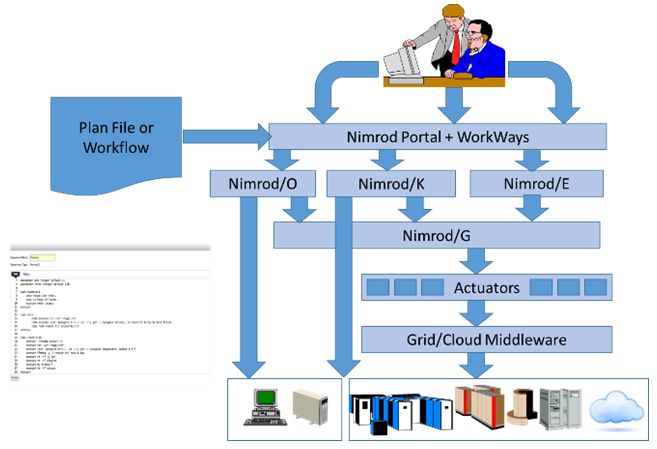
Nimrod/G
Core grid scheduler responsible for distributing work across multiple resources and aggregating results.
- Supported parameter sweeps with the ability to execute millions of jobs.
- Jobs defined via planfiles specifying parameters, tasks, and data management.
- Originally implemented in early Python, later rewritten in C.
Sample planfile
parameter aircraft_model files select anyof "A3??.dat" "737-*.dat"
parameter AoA label "Angle of attack" float range from -45 to 45 step 2.5
parameter winglets text select anyof "none" "fence" "blended" "raked"
parameter airspeed integer range from 50 to 600 step 50
parameter turbulence label "Normalized Reynolds" float random from 1 to 2

task main
	copy root:${aircraft_model} node:.
	copy root:wing_test.zip node:.
	exec unzip wing_test.zip
	shexec "./run_wing_test.sh ${aircraft_model} ${winglets} ${AoA} ${airspeed} ${turbulence} >> output.${jobindex}"
	shexec "zip results.${jobindex} *"
	copy node:results.${jobindex}.zip root:.
endtask
Nimrod/O
Optimisation engine built on top of Nimrod/G.
- Supported single- and multi-objective optimisation.
- Extended planfile syntax with optimisation directives (schedule files).
- Written in C.
Sample Schedule File
parameter p integer range from 35 to 60
parameter q integer range from 2 to 17
parameter r integer range from 15 to 45

task main
   copy  bead.data node:bead.data
   copy  beader node:beader
   node:execute  ./beader $p $q $r > final
   copy  node:final output.$jobname
endtask

method simplex
  starts 2 named "Simplex"
    starting points random
    tolerance 0.000
  endstarts
endmethod
Nimrod/K
Reimplementation of Nimrod/G for the Kepler Project.
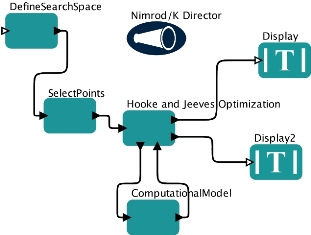
- Enabled visual workflow construction with Kepler’s actor–director model.
- Allowed parameter sweeps and distributed execution via a GUI.
- Written in Java.
Nimrod/OK
Optimisation integration for Kepler and Nimrod/K.
- Partial reimplementation of Nimrod/O.
- Introduced an optimisation actor to support feedback loops and optimisation pipelines.
- Written in Java.
Embedded Nimrod
Lightweight variant of Nimrod/G designed for use within a single HPC cluster.
- Configured via inline comments in job scripts, similar to PBSPro and SLURM.
- Provided a simpler on-ramp for parameter sweeps without complex configuration.
- Implemented in C++, coordinating a local Nimrod/G instance.
- Originally developed as a shell script to bootstrap Nimrod/G instances for testing.
- See also: Embedded Nimrod: Straightforward HTC in HPC environments.
Sample Job Script
| |
Development History
Assessment and Modernisation
Inherited a legacy codebase that had been largely unmaintained for nearly 20 years.
Identified major issues including:
- Unsafe database queries using string concatenation.
- Poor error handling that left orphaned jobs and resources.
- Rudimentary, regex-based parsing of planfiles.
Determined the codebase was unsalvageable and initiated a complete reimplementation.
Reimplementation of Nimrod/G
- Reimplemented Nimrod/G as a modern Java-based scheduler with improved safety, maintainability, and portability.
- Introduced structured error handling, resource cleanup, and consistent parsing.
- Ensured cross-platform compatibility for deployment across diverse HPC environments.
Outcome
- Delivered an updated and maintainable foundation for distributed computing at RCC.
- Simplified user adoption through Embedded Nimrod, reducing reliance on staff intervention.